

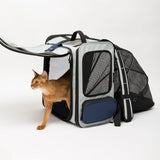




One moment it's sprinting across your living room at full speed. The next, it's curled up on your lap, purring like nothing happened. That's life with a Bengal cat. And once you've experienced it, there's really no going back.
The Bengal is one of the most talked-about cat breeds in the Netherlands right now, and it's not hard to see why. That wild, leopard-like coat. Those alert, intelligent eyes. The sheer energy that fills a room the moment a Bengal decides it's playtime. But before you fall completely in love, it's worth asking: does a Bengal actually suit your lifestyle?
What Kind of Cat Is the Bengal, Really?
The Bengal was developed in the 1960s by American geneticist Jean Mill, who crossed domestic cats with the Asian leopard cat. Her goal was simple: create a cat with the striking appearance of a wild animal and the temperament of a loving housecat. After many generations of selective breeding, she succeeded.
Today, Bengals sold as pets are at least five generations removed from their wild ancestors, referred to as F5 or higher. This is also a legal requirement in the Netherlands and Flanders: since July 2024, only F5 Bengals and beyond may be kept as domestic pets. Any reputable breeder will be able to confirm the generation of their kittens.
What makes the Bengal so visually distinctive is its coat: short, silky, and covered in rosettes or a marbled pattern that genuinely resembles a miniature leopard. The colours range from warm brown to silver and snow. Up close, the texture is surprisingly soft.

A Character That Keeps You on Your Toes
Bengals are not your average lap cat. They are highly intelligent, curious, and deeply social, but on their own terms. They'll follow you from room to room, comment on everything you do with a chirp or a trill, and generally make sure they're never left out of whatever's happening in the house.
They love water. Don't be surprised to find your Bengal pawing at a dripping tap or jumping into the shower with you. They collect things too: hair ties, pens, small toys. And stash them in spots you won't discover for weeks.
Most Bengals bond strongly with their person, but they're not always the type to sit passively and be held. They want interaction, movement, and stimulation. They're more "let's play" than "let me snuggle." And that's exactly what makes them so addictive to live with.

What a Bengal Actually Needs
This is where honesty matters most. A Bengal is a commitment. Not because they're difficult, but because they have genuine needs that can't be ignored.
They need at least 30 to 60 minutes of active playtime every day. Not just a toy on the floor, but real engagement: chasing, hunting, climbing, problem-solving. A bored Bengal will find its own entertainment, and you probably won't enjoy their choices.
Height is important. Bengals love to climb and survey their territory from above. A tall, sturdy cat tree is not optional. It's essential. Add wall-mounted shelves if you can.
Their coat is low-maintenance and needs just a weekly brush to remove loose hairs and keep it looking its best.
That adventurous spirit also means a Bengal can genuinely enjoy going outside on a leash. Many Bengal owners are surprised by how quickly their cat takes to it.

The YMOAs Striped Cat Harness and Leash Set is a great match for the Bengal's bold personality: breathable H-shaped design, adjustable fit, and a look that's hard to miss on your neighbourhood walk.
Read more about taking your cat on outdoor adventures.
Planning to take your Bengal further afield? A well-ventilated, secure cat carrier makes all the difference when travelling. Bengals tend to handle transport better than most breeds once they're used to their carrier, so introducing it early is worth the effort.
Nutrition matters too. Bengals are active cats with higher energy needs, so a high-protein diet is the right starting point. Fresh water should always be available. Given their love of water, a drinking fountain often works better than a standard bowl. Need ideas for keeping your Bengal mentally stimulated at home? This guide on indoor playtime has plenty to get you started.

Is a Bengal the Right Cat for You?
Here's the honest answer: a Bengal is an incredible companion for the right person, and a frustrating mismatch for the wrong one.
A Bengal suits you if you're home fairly often, enjoy active engagement with your cat, and have the space (and patience) for a cat that climbs, explores, and vocalises freely. They do well with children and other pets when properly socialised from a young age.
A Bengal is probably not for you if you're away for long hours daily, prefer a calm and quiet household, or are looking for an easy, low-maintenance pet. This is a cat that needs you. Not just your presence, but your attention.
The good news is that Bengals are remarkably trainable. Clicker training works beautifully with them. They can learn to walk on a leash, fetch small objects, and even open doors. If you put the time in, the Bengal will absolutely meet you halfway.

Keeping Your Bengal Healthy
Bengals are generally robust cats, but a few health points are worth knowing. They can be prone to hypertrophic cardiomyopathy (a heart muscle condition), progressive retinal atrophy, and hip dysplasia. Always ask a breeder for health test results on the parent cats.
Their lifespan is typically 12 to 16 years with good care. Regular vet check-ups, dental care, and a balanced diet go a long way. Keep nails trimmed every two weeks, and check the ears weekly for any buildup.
One more thing: Bengals are highly sensitive to bacterial contamination in food. Always use fresh food, clean bowls regularly, and take any signs of digestive upset seriously.
Living with a Bengal means committing to a cat that is genuinely alive in every sense of the word. Loud, curious, opinionated, affectionate. It's not always easy. But it is always worth it. 🐈
Bronnen
Hart, B. L., & Hart, L. A. (2013). Your ideal cat: Insights into breed and gender differences in cat behaviour. Purdue University Press.
Teng, K. T., et al. (2024). Feline lifespan and breed-associated mortality in the UK. Journal of Feline Medicine and Surgery.
Wikipedia. (2024). Bengaal. Geraadpleegd via https://nl.wikipedia.org/wiki/Bengaal
Praslin Bengals. (2026). Bengaal kittens en de huis- en hobbydierenlijst. Geraadpleegd via https://www.praslin.nl/bengaal-kittens/