

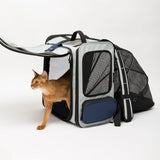




Cats look effortless. They nap, stretch, blink slowly at you like a tiny zen master… and somehow still run the household. But the “easy” vibe can be misleading: indoor cats thrive on small, consistent choices we make every day—food, water, play, space, and stress-free handling.
We’re not here to overcomplicate your life. Think of this as a simple blueprint you can actually stick to.
1) Food: build a routine, not a rollercoaster
A cat’s stomach (and mood) loves predictability. When meals are random, some cats become anxious, picky, or “enthusiastically vocal” at 5 a.m.
Try this:
-
Fixed mealtimes (2–4 per day depending on your schedule and your vet’s advice).
-
Measure portions instead of free-pouring “just a little extra.”
-
Use feeding as enrichment: puzzle feeders or “hunt the kibble” games (especially for indoor cats).
Wet vs dry? Many households use a combination—dry for convenience and dental texture, wet to support hydration and satiety. International Cat Care notes wet food can be helpful for cats prone to urinary issues, constipation, or overweight (International Cat Care, 2024a). (iCatCare)
YMOAs-ready tip: If your cat tends to inhale food like they’re on a game show, consider serving meals in a way that slows them down. Pair it with a stable feeding setup—an elevated bowl can support a more comfortable posture for some cats (ask your vet if your cat has GI issues or arthritis).

2) Water: hydration is a health strategy, not a “nice to have”
Cats often drink less than we expect—partly because their desert ancestry makes them good at conserving water. The problem: some common feline issues (kidney disease, bladder/urinary problems) benefit from increased water intake.
International Cat Care provides practical ways to encourage drinking: multiple water stations, trying different bowl shapes/materials, keeping water away from food/litter, and considering wet food as a hydration helper (International Cat Care, 2024b). (iCatCare)
Try this simple “water audit”:
-
Put 2–3 bowls around the home (yes, even if you live small).
-
Refresh daily; some cats dislike “stale” water.
-
If your cat prefers moving water, a fountain can help.

3) Play: 10 minutes that change everything
If you live with a cat, you’ve seen the pattern: bored cat → chaos cat. Indoor cats need outlets for natural behaviors like stalking, pouncing, chasing, and problem-solving.
Cornell’s Feline Health Center emphasizes that toys and play support exercise, mental stimulation, and can help prevent issues like obesity and destructive behavior (Cornell Feline Health Center, n.d.). (vet.cornell.edu)
A play routine that works for real humans:
-
2 sessions a day (even 8–12 minutes counts).
-
Use a wand toy to mimic prey: slow, hide, dart, pause.
-
End with a small meal or treat: “hunt → eat → groom → nap” is the natural rhythm.
4) Home enrichment: think vertical + safe hiding + choice
Cats don’t just want space—they want layers. A good indoor setup offers:
-
Vertical perches (shelves, cat trees, window seats)
-
Hiding spots (covered beds, boxes)
-
Scratch zones (vertical + horizontal)
-
Calm zones away from noise
A veterinary review on environmental enrichment highlights that optimizing the indoor environment reduces stress and supports wellbeing (Herron & Buffington, 2012). (pmc.ncbi.nlm.nih.gov)
Tiny upgrade, big impact: Place one perch near a window. Add a scratcher nearby. Watch your cat suddenly become a nature documentary critic.

5) Stress-free carrier training: your future self will thank you
Most cats dislike the carrier because it predicts “vet + weird smells + betrayal.” But we can rewire that association.
The AVMA recommends confining cats to a carrier during car travel for safety and to prevent escape (American Veterinary Medical Association, n.d.). (avma.org)
International Cat Care also suggests practical steps like covering the carrier and preparing calmly for vet visits (International Cat Care, 2024c). (iCatCare)
Make the carrier boring (that’s a compliment):
-
Leave it out at home, door open.
-
Add a soft blanket with home scent.
-
Toss treats inside casually.
-
Do short “carrier hangs” without going anywhere.
6) Handling and vet visits: calm techniques matter
Fear and stress aren’t just emotional—they affect the exam quality and your cat’s wellbeing. The 2022 AAFP/ISFM Cat Friendly Veterinary Interaction Guidelines emphasize giving cats choice, gentle handling, and minimizing fear during interactions (Rodan et al., 2022). (journals.sagepub.com)
FelineVMA guidance for vet visits also highlights using familiar blankets, covering the carrier, and pheromone products as options (FelineVMA, 2024). (catvets.com)
At home, practice “consent-based” touch:
-
Reward calm interactions.
-
Stop before your cat is overwhelmed.
-
Keep nail trims short and positive (or outsource to a pro).

7) The “cat reset” checklist (save this)
If your cat seems off—more hiding, less play, weird litter box changes—start here:
-
Eating normally?
-
Drinking more/less?
-
Litter box: frequency, amount, straining?
-
Energy + grooming changes?
-
Any new stressors (visitors, moves, schedule changes)?
If you see appetite loss, straining to urinate, or sudden lethargy—contact your vet. Cats are masters at subtle symptoms.
References (APA 7th)
American Veterinary Medical Association. (n.d.). Traveling with your dog or cat. (avma.org)
American Veterinary Medical Association. (2023). Traveling with your pet [PDF brochure]. (ebusiness.avma.org)
Cornell Feline Health Center. (n.d.). Safe toys and gifts. Cornell University College of Veterinary Medicine. (vet.cornell.edu)
FelineVMA. (2024). Visiting your veterinarian [PDF]. (catvets.com)
Herron, M. E., & Buffington, C. A. T. (2012). Environmental enrichment for indoor cats: Implementing enrichment strategies. Journal of Feline Medicine and Surgery, 14(8), 555–564. (pmc.ncbi.nlm.nih.gov)
International Cat Care. (2024a, October 28). Should I feed my cat wet or dry food? (iCatCare)
International Cat Care. (2024b). Encouraging your cat to drink: A guide for caregivers [PDF]. (iCatCare)
International Cat Care. (2024c). Taking your cat to the veterinary clinic [PDF]. (iCatCare)
Rodan, I., et al. (2022). 2022 AAFP/ISFM cat friendly veterinary interaction guidelines: Approach and handling techniques. Journal of Feline Medicine and Surgery, 24(11), 1011–1045. (journals.sagepub.com)