




Updated: June 2026
Cats need more than food and a warm spot on the sofa. They need to hunt, stalk, bat, and pounce. Without that outlet, boredom sets in fast, and a bored cat finds its own entertainment in ways you probably won't enjoy.
The good news is that keeping your cat mentally and physically stimulated doesn't require expensive toys. Some of the most effective cat enrichment comes from things you already have at home. We've tested these three DIY toys with our own cats, and they hold up surprisingly well. Here's what actually works, why it works, and a few things to watch out for along the way.
If you want to understand why play matters so much for your cat's overall wellbeing, our guide on indoor cat enrichment covers the full picture.
Crinkly Paper Ball – The Simplest DIY Cat Toy
🏠 What You Need:
- One sheet of A4 paper or any scrap paper
✂️ How to Make It:
- Crumple the paper into a lightweight ball.
- 🐾 Pro Tip: Tease your cat with the ball before giving it to them—this builds curiosity and excitement!

🐱 Why Cats Love It
Cats are instinctively drawn to objects that move unpredictably and make noise. A crinkled paper ball ticks both boxes. The sound mimics the rustle of small prey moving through dry leaves, which triggers the hunting response almost immediately. It's also light enough to be batted around easily, which keeps the play session going longer.
Dr. John Bradshaw, cat behaviour researcher and author of Cat Sense, notes that domestic cats retain the same hunting drive as their wild ancestors. Even well-fed indoor cats will engage enthusiastically with anything that moves like prey.
⚠️ Safety Tip: Use plain paper only. Avoid plastic wrap, metallic paper, or anything with staples or tape. These can be swallowed or cause injuries.
DIY Yarn Pom-Poms – Soft and Fluffy Fun
🏠 What You Need:
- A fork
- A bundle of soft yarn
- Scissors
✂️ How to Make It:
- Wrap the yarn around the fork several times.
- Tie a separate piece of yarn tightly around the middle of the wrapped bundle.
- Slide the bundle off the fork and cut the looped ends on both sides.
-
Fluff out the cut ends and trim any uneven pieces to shape the pom-pom.
🎨 Want a detailed tutorial? Check out this step-by-step guide on Instructables

🐱 Why Cats Love It
Soft, fluffy textures appeal to cats because they resemble small prey animals like mice or birds. The pom-pom is also light enough to be carried and dropped, which satisfies the full hunting sequence: stalk, catch, carry, and release. Many cats will bring the pom-pom back to you repeatedly once they work out that you'll throw it again.
⚠️ Safety Tip:
Never give your cat loose yarn or string to play with unsupervised. Yarn can cause serious intestinal blockages if swallowed. The pom-pom needs to be tied securely so no long strands come loose during play.
DIY Treat Dispenser – A Fun Puzzle for Smart Cats
🏠 What You Need:
- A toilet paper roll
- Small cat treats
- Optional: a paper bag with handles removed, or an empty plastic container with smooth edges
✂️ How to Make It:
- Fold the ends of the toilet paper roll inward to partially close both openings.
- Place a small amount of treats inside.
-
Set it on the floor and let your cat figure out the rest.

Alternative Methods:
Use a paper bag with the handles removed and hide treats inside. Or repurpose a clean plastic food container, making sure all edges are smooth before use.
🐱 Why Cats Love It
Food puzzles tap into the same instinct as hunting. Cats are built to work for their food, and when a meal or treat requires effort, it's more satisfying. Research from the UC Davis School of Veterinary Medicine found that food puzzles reduce stress behaviours, decrease overeating, and improve general wellbeing in indoor cats. Many cats that seem indifferent to toys will engage intensely with a treat dispenser.
This kind of mental stimulation also helps cats that tend to over-groom or show signs of anxiety. If your cat's grooming has become excessive, it's worth reading our guide on cat hairballs, which covers how stress and boredom can contribute to the problem.
⚠️ Safety Note: Remove any plastic from the toilet paper roll before use. Supervise the first few sessions to make sure your cat isn't trying to eat the cardboard.

When DIY Isn't Enough: Upgrading to a Real Slow Feeder
The treat dispenser works well as an occasional enrichment activity, but if your cat eats too quickly at mealtimes, a dedicated slow feeder makes the difference every single day. Research published by PetMD shows that slowing down eating reduces bloating, prevents vomiting after meals, and improves digestion in cats.
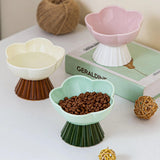
The YMOAs Ceramic Slow Feeder Bowl with Acacia Wood Stand is designed for exactly this. The ceramic construction is hygienic, easy to clean, and durable in a way that cardboard never will be. The wooden stand raises the bowl to a comfortable eating height, which reduces strain on your cat's neck during meals.
If you want both a slow feeder and a water bowl in one setup, the YMOAs Elevated Ceramic Food and Water Bowl Set with Wooden Stand covers both in a single, cohesive design.

Frequently Asked Questions
What household items can I use to make cat toys at home?
Paper, soft yarn, toilet paper rolls, paper bags (with handles removed), and clean cardboard are all safe starting points. The key is avoiding anything with small parts that could be swallowed, loose threads, sharp edges, or toxic materials. Plain, untreated materials work best.
How do I know if a homemade cat toy is safe?
Check that there are no loose parts, sharp edges, or strings long enough to wrap around a cat's paw or neck. Supervise new toys the first few times, especially with younger or more destructive cats. If a toy starts to fall apart, replace it.
Why does my cat ignore expensive toys but love a paper ball?
Cats respond to movement and unpredictability more than to production value. A crinkled paper ball that skitters across the floor engages the hunting instinct more effectively than a stationary plush toy. Novelty also plays a role: rotating toys in and out of rotation keeps them interesting longer.
How often should I play with my indoor cat?
Most adult cats benefit from two short play sessions a day, around 10 to 15 minutes each. Kittens need more. The goal is to let the cat complete the full hunting sequence: stalk, chase, catch, and then wind down. Ending with a small treat simulates a successful hunt and helps the cat settle.
Can DIY cat toys help with boredom and overgrooming?
Yes. Boredom is one of the main drivers of stress-related overgrooming in indoor cats. Regular play and mental stimulation reduce the need to self-soothe through excessive grooming. If overgrooming is already a concern, enrichment toys are a good first step, but it's also worth speaking to your vet to rule out skin or anxiety issues.
Making your own cat toys takes five minutes and costs almost nothing. The real investment is the time you spend playing with your cat, and that's the part they remember. 🐾
References:
References
Bradshaw, J. (2013). Cat Sense: How the New Feline Science Can Make You a Better Friend to Your Pet. Basic Books.
Dantas, L. M. S., Delgado, M. M., Johnson, I., & Buffington, C. A. T. (2016). Food puzzles for cats: Feeding for physical and emotional wellbeing. Journal of Feline Medicine and Surgery, 18(9), 723-732. https://doi.org/10.1177/1098612X16643753
International Cat Care. (n.d.). Encouraging your cat to be active and play. Retrieved from https://icatcare.org/advice/encouraging-your-cat-to-be-active-and-play/
UC Davis School of Veterinary Medicine. (n.d.). Food puzzles for cats. Retrieved from https://www.vetmed.ucdavis.edu/news/food-puzzles-cats